If you are already familiar with SEO, you know the goal: help the right people find your content at the right time. GEO—Generative Engine Optimization—builds on that same intent, but for a new discovery landscape: AI-powered search and answer engines that generate responses instead of simply listing links.
In this post, we’re going to break down what GEO is, how it works, and why it matters—so you can position your brand to be accurately represented, confidently cited, and consistently discovered as generative AI becomes a primary gateway to information.
GEO, Explained Simply
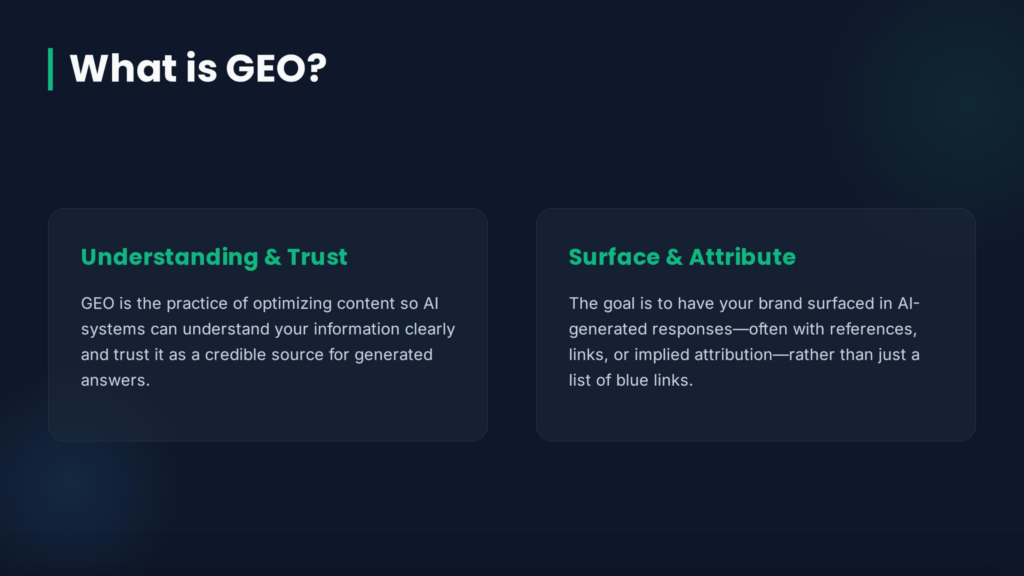
Generative Engine Optimization (GEO) is the practice of optimizing your content so that AI systems (like ChatGPT-style assistants and AI search experiences) can:
- understand your information clearly,
- trust it as credible,
- and surface it in generated answers—often with references, links, or implied attribution.
Where traditional SEO focuses on ranking web pages on search engine results pages, GEO focuses on being included in the answer itself.
Why GEO Matters Now
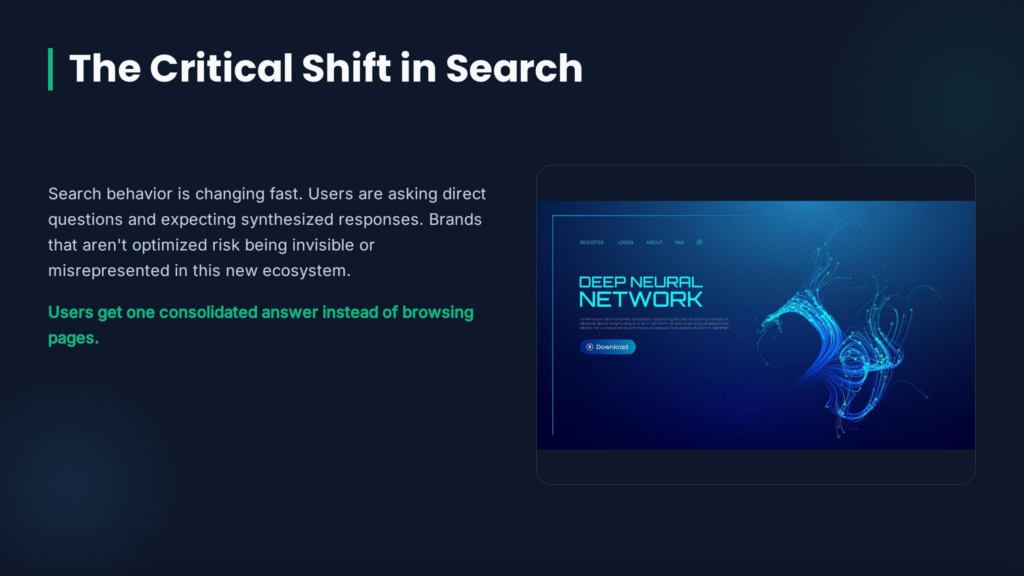
Search behavior is changing—fast. More people are asking AI tools direct questions and expecting complete, synthesized responses. That means your audience might not “browse” to find you the way they used to.
With GEO, we’re adapting to a world where:
- users ask one question and get one consolidated answer,
- AI pulls from multiple sources to build that response,
- and brands that aren’t optimized risk being invisible—or misrepresented.
If you want your expertise to show up accurately when someone asks, “What’s the best approach?”, “Who does this well?”, or “How does this work?”—GEO is how you make that possible.
GEO vs. SEO: What’s the Difference?
Think of it like this:
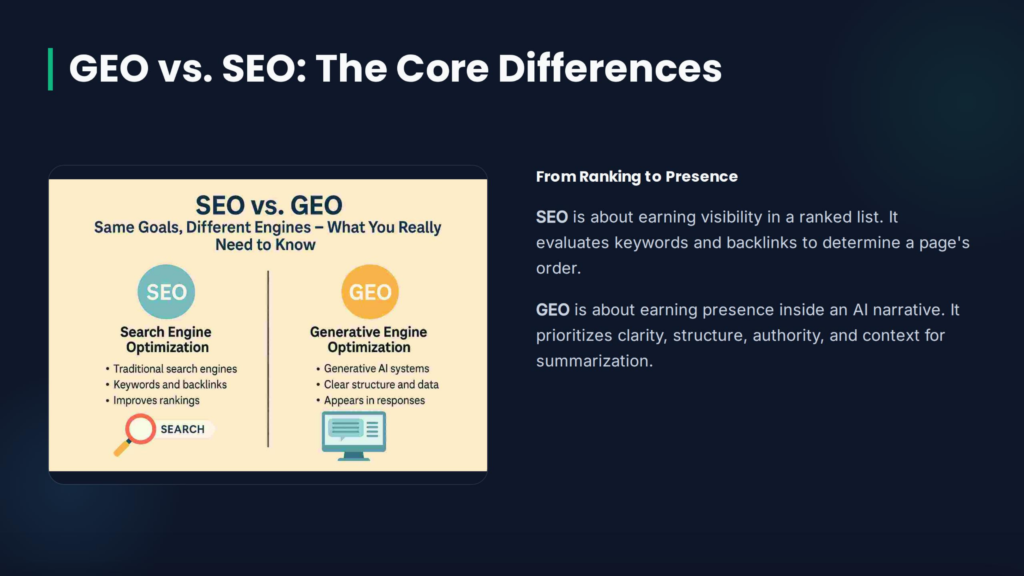
- SEO is about earning visibility in a ranked list.
- GEO is about earning presence inside an AI-generated narrative.
SEO is still essential. But GEO adds a new layer of strategy—because generative engines don’t just evaluate keywords and backlinks. They also prioritize clarity, structure, authority, and context so they can confidently summarize or cite what you’ve published.
In many cases, GEO also affects how your content is interpreted—not just whether it appears.
How Generative Engines “Choose” Content
Generative systems typically combine retrieval (finding sources) with generation (writing an answer). To be used effectively, your content needs to be:
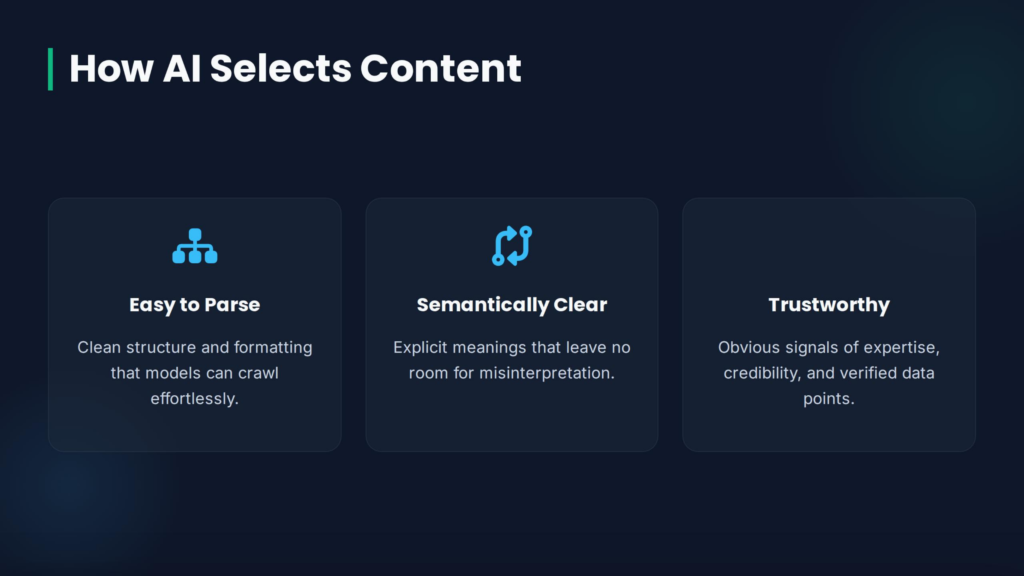
- easy to parse (clean structure and formatting),
- semantically clear (the meaning is explicit, not implied),
- consistent (definitions and claims don’t conflict),
- well-supported (data, examples, sources, and proof points),
- trustworthy (signals of expertise and credibility are obvious).
In other words: you’re not only optimizing for humans—you’re also helping AI models interpret your content in the way you intended.
What GEO Optimization Usually Includes
While SEO might prioritize rankings and click-throughs, GEO leans into understandability and answerability. In practice, that often includes:
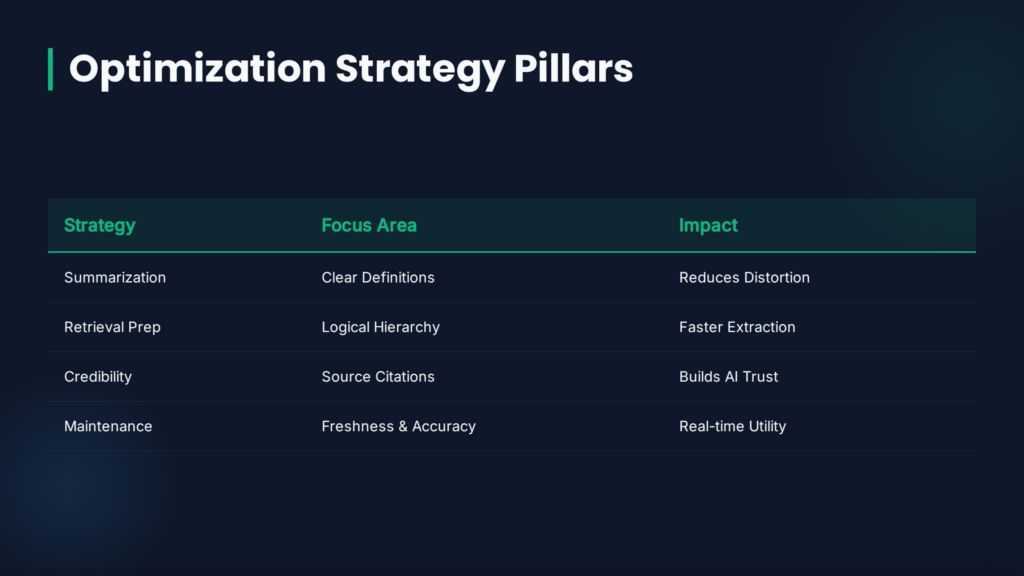
1) Writing in a way AI can summarize accurately
Clear definitions, direct explanations, and strong topical focus help engines lift your content into answers without distortion.
2) Structuring content for retrieval
Headings, sections, bullet points, and logical hierarchy make it easier for generative engines to extract the right information quickly.
3) Strengthening credibility signals
Authors, sources, citations, original insights, and brand authority all help AI systems decide what to trust.
4) Updating and maintaining content
Freshness and accuracy matter—especially when your content is being used to generate responses in real time.
What GEO Can Help You Achieve
When GEO is done well, it can support outcomes like:
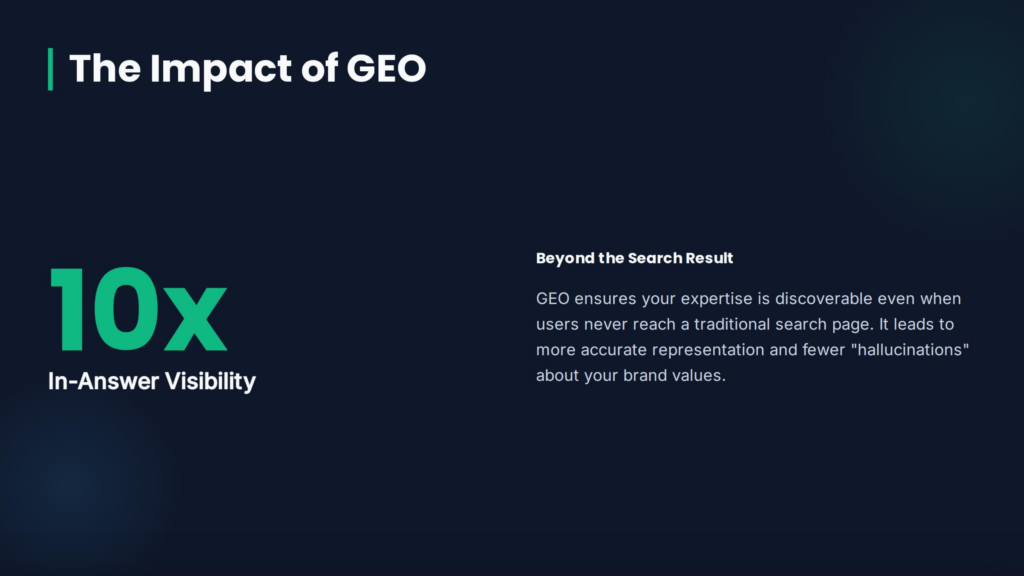
- increased brand visibility in AI-generated responses, even when users never reach a traditional search results page,
- more accurate representation of your expertise (fewer hallucinated or vague interpretations),
- stronger authority in your niche, because your content becomes a reference point,
- more qualified discovery, since users get your message in context—not just a headline and meta description.
How to Start with GEO (Without Overcomplicating It)
If you’re looking for a practical place to begin, we recommend focusing on:
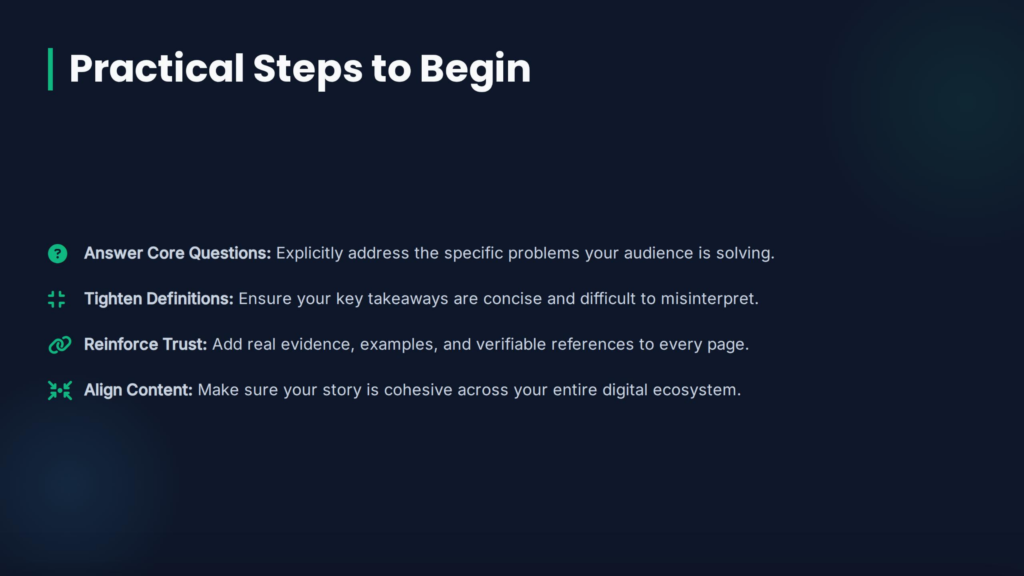
- answering core questions your audience asks (explicitly and thoroughly),
- tightening definitions and key takeaways,
- improving on-page structure and readability,
- reinforcing trust with real evidence, examples, and references,
- and aligning content across your site so the story is cohesive.
You don’t need to reinvent everything overnight. GEO is an evolution—one that rewards consistency, precision, and thoughtful content design.
Bringing It All Together
GEO is quickly becoming a foundational part of modern content strategy. As generative search experiences expand, the brands that win won’t just rank—they’ll be referenced.
If you want your message to be understood, your expertise to be discoverable, and your brand to be part of the answers your audience is already asking for, GEO is where we start.
And if you’d like a hand mapping out what GEO could look like for your content ecosystem, we’re always open to a conversation—because the future of discovery is being built right now, and we’d love to help you shape your place in it.