
Introduction: The Boardroom Disconnect
Walk into the boardroom of almost any mid-sized shipyard, marine OEM, or offshore service provider during Q4 budgeting season, and you will likely hear a variation of the same phrase:
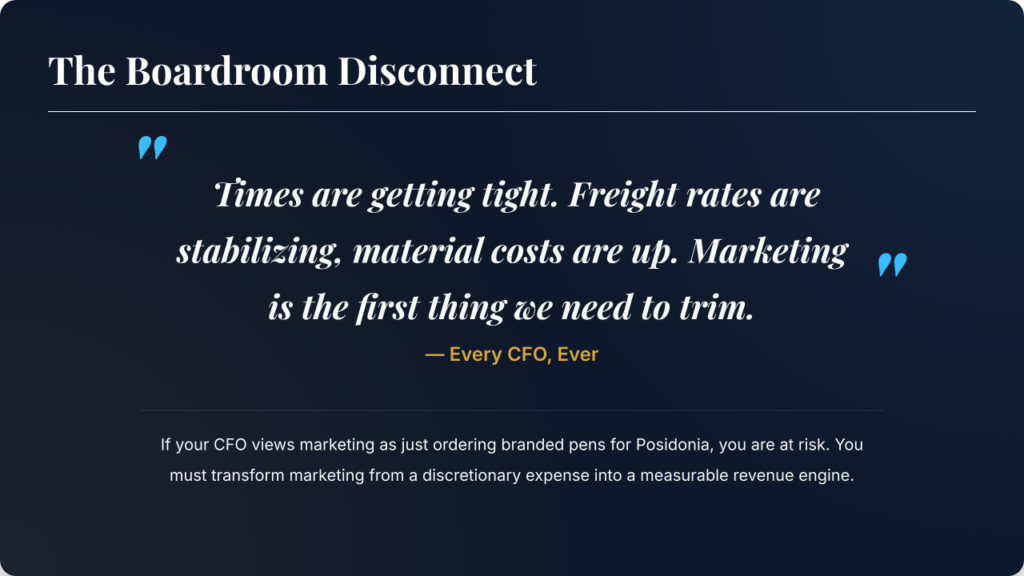
“Times are getting tight. Freight rates are stabilizing, material costs are up. Marketing is the first thing we need to trim.”
For decades in the maritime industry, marketing has been viewed by Chief Financial Officers (CFOs) and Managing Directors as a discretionary expense. It was the department responsible for ordering the branded pens for Posidonia, booking the 10×10 booth at SMM Hamburg, and ensuring the company logo looked nice on a brochure. When budgets tightened, cutting marketing was the easiest way to protect the bottom line without firing engineers or salespeople.
If your CFO still views your department this way, you are not alone. But in 2026, operating with this mindset is a massive organizational risk.
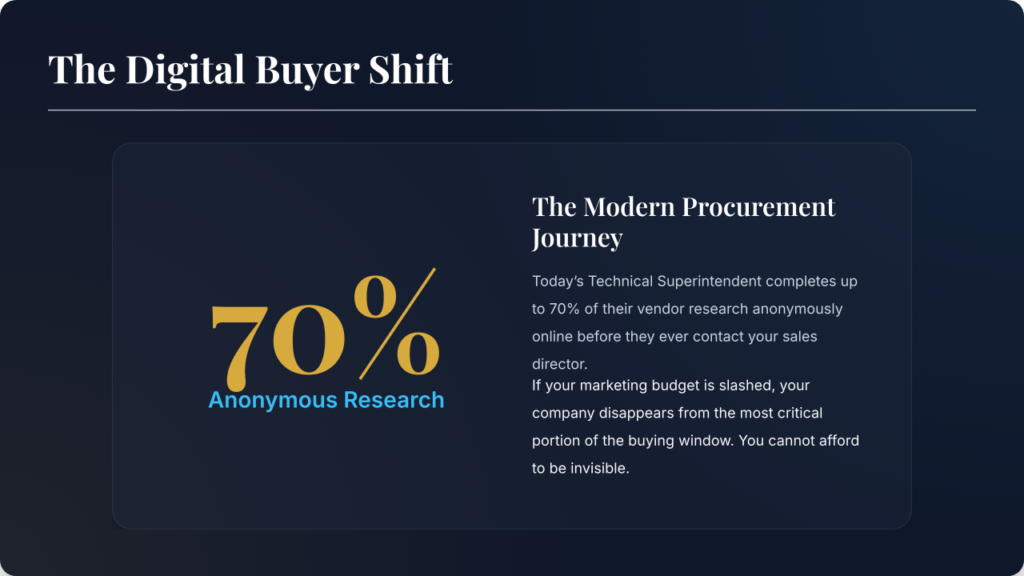
The buyer journey in the maritime sector has irrevocably changed. The modern Technical Superintendent, Fleet Manager, or Procurement Director is completing up to 70% of their vendor research anonymously online before they ever pick up the phone to call your sales director. If your marketing budget is slashed, your company disappears from that 70% of the buying window.
To defend your budget, you cannot just ask for “more money for brand awareness.” CFOs do not care about brand awareness. They care about risk mitigation, cash flow, and return on investment (ROI).
To secure the capital you need to drive digital growth, you must stop speaking like a creative director and start speaking like a financial analyst. You must transform marketing from an “expense” into a measurable “revenue engine.”
This guide will show you exactly how to reframe your maritime marketing budget, shift your metrics, and present a Marketing P&L (Profit and Loss) framework that your CFO will actually respect.
Section 1: Why Your CFO Hates “Vanity Metrics”
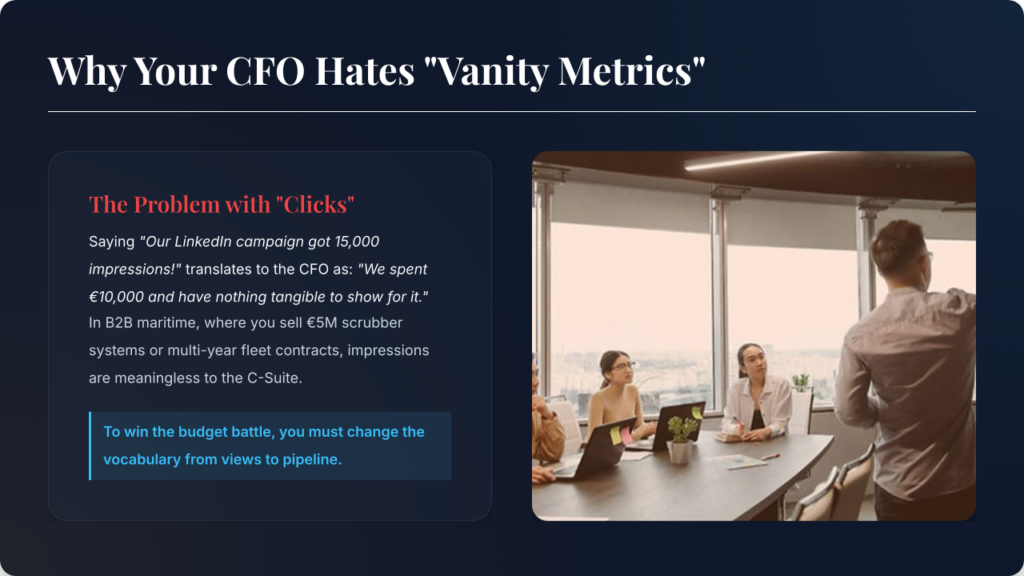
Imagine sitting across from a CFO who is managing multi-million-dollar capital expenditures, supply chain logistics, and fluctuating steel prices. You pull up a PowerPoint slide and proudly announce: “Our latest LinkedIn campaign got 15,000 impressions, and website traffic is up 20%!”
The CFO’s internal translation of that statement is: “You spent €10,000 and we have absolutely nothing tangible to show for it.”
In the maritime B2B space—where you might be selling a €5 million ballast water treatment system, a complex vessel retrofit, or a multi-year fleet maintenance contract—clicks, likes, and impressions are virtually meaningless to the C-suite. These are known as Vanity Metrics.
Vanity metrics tell you that people are looking at you, but they do not tell you if those people are qualified buyers, nor do they prove that those views are translating into revenue.
The Problem with the Traditional Maritime Budget
Historically, maritime marketing budgets have been heavily skewed toward events. A typical budget might look like this:
- 60% Trade Shows (Booth space, travel, hotels, client dinners)
- 20% Print Advertising (Trade magazines)
- 10% Collateral (Brochures, business cards, giveaways)
- 10% Digital (A basic website and occasional social media posts)
The CFO accepts the trade show budget because “that’s where the sales team shakes hands and closes deals.” It feels tangible. But when you ask to reallocate €50,000 toward Account-Based Marketing (ABM) on LinkedIn or technical content creation, the CFO demands immediate proof of ROI.
If you try to prove that ROI using vanity metrics, you will lose the budget battle. You must change the vocabulary.
Section 2: Changing the Vocabulary (Metrics That Matter)
To defend your budget, you must draw a direct, mathematically sound line between the money you spend and the revenue the sales team closes. You need to report on Pipeline Metrics.
Here are the four metrics you must bring to your next budget meeting.
1. Cost Per Qualified Lead (CPQL)
A “Lead” is someone who downloads a whitepaper. A “Qualified Lead” (often split into Marketing Qualified Leads/MQLs and Sales Qualified Leads/SQLs) is a Fleet Manager at a target shipping line who has downloaded your whitepaper, visited your pricing page, and requested a consultation.
Your CFO needs to know exactly how much it costs to generate one of these. Calculation: Total Marketing Spend / Total Number of Qualified Leads Generated.
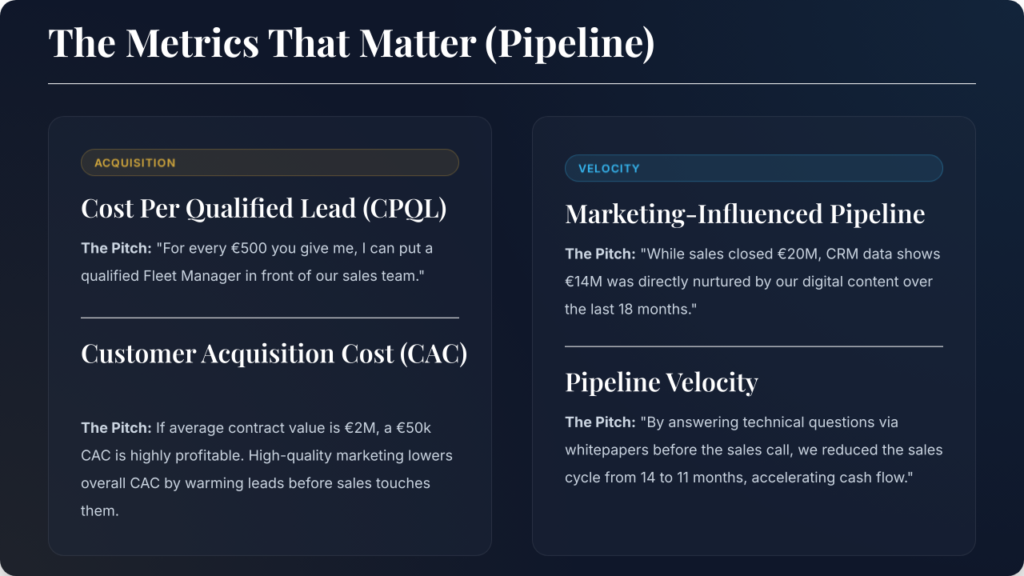
How to use it: “Last year, our digital lead generation campaigns cost €40,000 and generated 80 highly qualified conversations with technical directors. Our Cost Per Qualified Lead is €500. For every €500 you give me, I can put a qualified buyer in front of our sales team.”
2. Customer Acquisition Cost (CAC)
This is the holy grail metric for a CFO. How much total money (marketing + sales salaries + software) does it cost to win one net-new signed contract? Calculation: (Total Marketing Spend + Total Sales Spend) / Number of New Customers Won.
How to use it: In maritime, where a single contract can be worth millions, the CAC can safely be quite high. If your average contract value is €2,000,000, a CFO will gladly accept a CAC of €50,000. If you can prove that your marketing efforts are actively driving down the overall CAC by warming up leads before sales touches them, your budget becomes untouchable.
3. Marketing-Influenced Pipeline
In complex maritime sales, the cycle can take 12 to 24 months. Marketing rarely gets “last-click” credit for a multi-million-dollar deal. The salesperson who shook the hand gets the credit.
However, you must track Marketing-Influenced Pipeline. Did that buyer read three of your technical articles, attend your webinar, and click a LinkedIn ad during that 18-month sales cycle? If yes, marketing influenced that revenue.
How to use it: “While the sales team closed €20M in Q3, our CRM data shows that €14M of that revenue was directly influenced by our digital content nurturing campaigns over the last 12 months. Cutting our budget jeopardizes the pipeline for 2027.”
4. Pipeline Velocity
This metric measures how fast a lead moves from initial contact to a signed contract. High-quality marketing speeds this up. By answering a buyer’s technical questions via whitepapers and case studies before they talk to sales, you shorten the sales cycle.
How to use it: “Before we implemented our technical content strategy, our average sales cycle was 14 months. It is now 11 months. We are accelerating cash flow by a full quarter.”
Section 3: The Maritime Marketing P&L Template
When presenting your budget request, do not just hand over an Excel sheet with line items for “Website Hosting,” “Ad Spend,” and “Travel.”
Group your expenses strategically into a framework that mirrors an investment portfolio. We recommend the Foundations, Growth, and Dominance (FGD) Framework.
Here is how you should structure your presentation to the board.
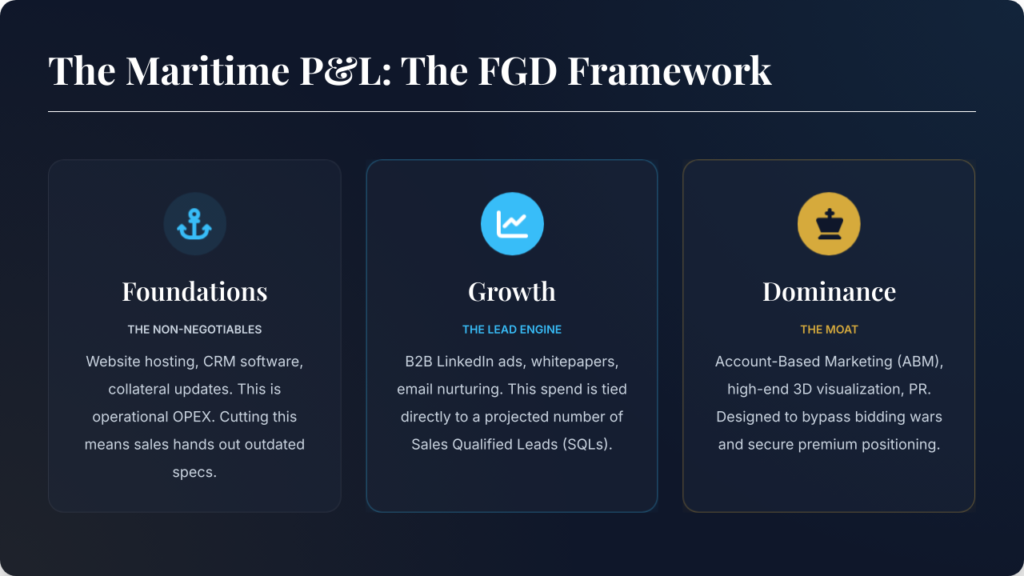
Phase 1: Foundational Spend (The Non-Negotiables)
This is the baseline capital required just to keep the lights on and ensure the company looks competent to the modern buyer.
- Website Maintenance & Hosting: (The digital storefront).
- CRM & MarTech Software: (HubSpot, Salesforce, tracking tools).
- Basic Content Production: (1-2 technical articles a month to maintain SEO).
- Collateral Updates: (Keeping spec sheets and digital brochures current).
- The Pitch to the CFO: “This is operational OPEX. If we cut this, our sales team is handing out outdated spec sheets, and our website will fail security audits from major procurement departments.”
Phase 2: Growth & Lead Gen (The Engine)
This is where you ask for investment to actively hunt for new business. This spend should be tied directly to a projected number of SQLs (Sales Qualified Leads).
- Targeted B2B Advertising: (LinkedIn Ads targeting specific job titles, e.g., “Naval Architect” or “Vessel Superintendent”).
- High-Value Content Creation: (Deep-dive whitepapers, lifecycle analysis reports, proprietary industry data).
- Email Nurturing Sequences: (Automated workflows to keep leads warm during long sales cycles).
- Trade Show Digital Support: (Pre-booking meetings via digital outreach before the expo begins).
- The Pitch to the CFO: “This is our revenue engine. We are requesting €60,000 for this tier. Based on our historical CPL of €500, this investment is modeled to generate 120 qualified sales conversations, resulting in a projected €4M in closed pipeline by Q4.”
Phase 3: Market Dominance (The Moat)
This is the advanced tier for industry leaders looking to capture market share from legacy competitors.
- Account-Based Marketing (ABM): (Hyper-personalized campaigns targeting the specific top 10 shipowners you want to win).
- High-End 3D Visualization: (Interactive models of your equipment or vessel designs to speed up stakeholder buy-in).
- PR & Thought Leadership: (Placing your CEO in TradeWinds, gCaptain, and securing keynote speaking slots).
- The Pitch to the CFO: “This tier is about outmaneuvering our biggest competitor. By investing heavily in ABM and 3D visualization, we can bypass the standard procurement bidding wars and position ourselves as the sole-source premium provider for the top tier of the market.”
Section 4: Anticipating CFO Objections
Even with a perfect P&L and pipeline metrics, a sharp CFO will push back. You must be prepared to answer these three common objections calmly and with data.
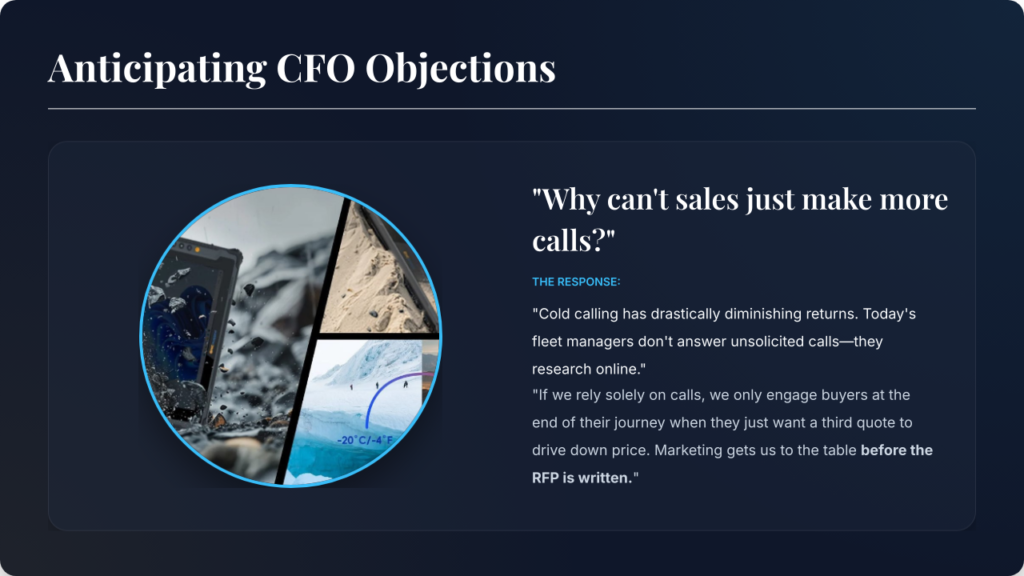
Objection 1: “Why can’t the sales team just make more calls? Why do we need to spend on marketing?”
Your Response: “Because cold calling is experiencing drastically diminishing returns in the maritime sector. Today’s technical buyers and fleet managers do not answer unsolicited calls from unknown numbers. They conduct their vendor research online. If we rely solely on sales calls, we are only engaging buyers at the very end of their journey—usually when they are just looking for a third quote to drive down the price of the vendor they actually want. Marketing gets us to the table before the RFP is written.”
Objection 2: “We’ve been in business for 50 years. Everyone in the industry knows who we are. Why spend on LinkedIn and content?”
Your Response: “They know who we were. The industry is undergoing a generational shift. The senior directors who know our legacy are retiring (The Silver Tsunami). The 35-year-old technical superintendent who is taking their place does not care that we’ve been around for 50 years; they care about our integration capabilities, our digital twin compatibility, and our emissions data. If we aren’t publishing that data where they are looking—like LinkedIn and Google—we are invisible to the next generation of decision-makers.”
Objection 3: “I’ll approve this digital budget, but I want to see signed contracts within 90 days. Deal?”
Your Response: “I want to set realistic expectations based on our sales cycle. Our average time from first touch to signed contract is 14 months. Marketing cannot force a shipowner to drydock a vessel faster. What I can promise in 90 days are leading indicators: a 20% increase in Marketing Qualified Leads, a higher volume of spec-sheet downloads from our target accounts, and 15 new highly qualified meetings booked for the sales team. The revenue will follow the sales cycle, but the pipeline growth will be visible this quarter.”
Conclusion: Earning Your Seat at the Table
Defending your marketing budget is not about begging for funds; it is about demonstrating business acumen.
When you stop talking about “brand awareness” and start talking about “Customer Acquisition Cost,” “Pipeline Velocity,” and “Return on Investment,” the dynamic in the boardroom changes completely. You transition from being viewed as an administrative expense to being recognized as a strategic revenue driver.
The maritime industry is modernizing rapidly. The companies that will dominate the next decade are not necessarily the ones with the oldest legacy; they are the ones that successfully integrate their deep engineering expertise with a modern, data-driven digital growth engine.
Your job as a maritime marketing leader is to secure the fuel for that engine.
Need Help Building Your Revenue Engine?
At Maritime Marketing Insights, we help shipyards, OEMs, and marine service providers transition from outdated marketing tactics to highly measurable, pipeline-driven strategies.
If you need a partner to help you execute this strategy—from high-end technical content creation to targeted Account-Based Marketing—explore our Strategic Retainer Packages (like the Dockyard or Command Bridge tiers).
Stop guessing your ROI. Book a Strategy Call today and let’s build a marketing engine your CFO will love.