Search is changing fast. Prospects aren’t just typing queries into Google and clicking ten blue links anymore—they’re asking ChatGPT, Gemini, Perplexity, and Google’s AI-powered experiences to summarise, recommend, and shortlist suppliers. If your maritime business isn’t showing up in those AI-generated answers, you’re effectively invisible at the exact moment buyers are deciding who to contact.
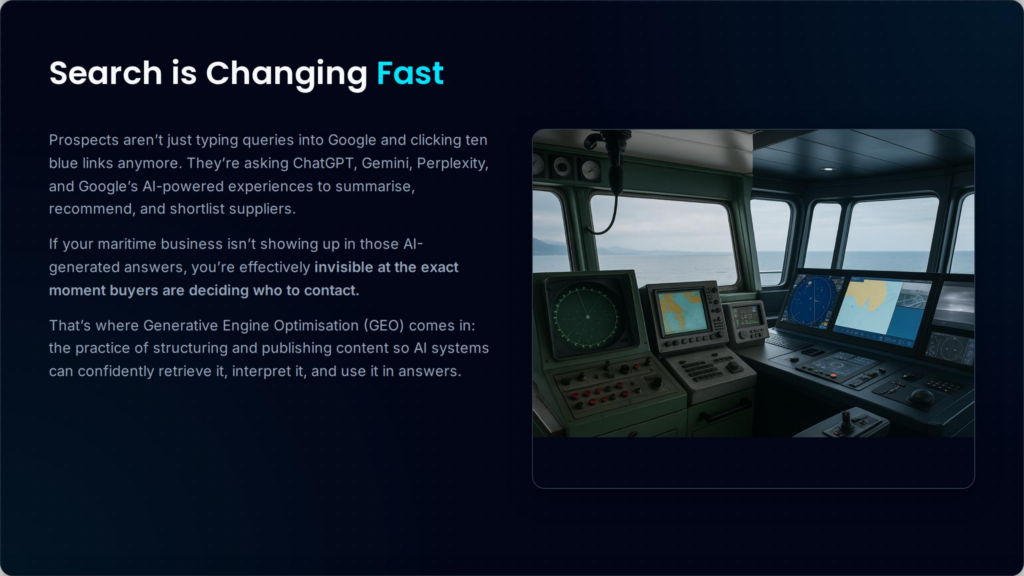
That’s where Generative Engine Optimisation (GEO) comes in: the practice of structuring and publishing content so AI systems can confidently retrieve it, interpret it, and use it in answers—often with a citation or brand mention.
This beginner-friendly guide is based on the foundational GEO best-practice concepts.
The goal:
Help maritime companies—owners, operators, brokers, shipyards, ports, martech teams, and service providers—build AI visibility in a practical, repeatable way.
What is GEO (and how is it different from SEO)?
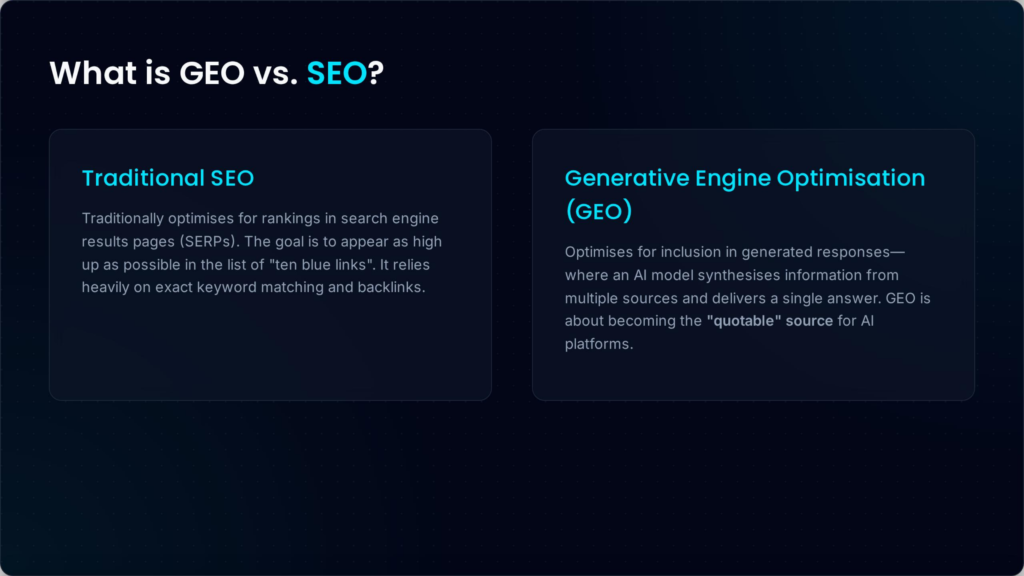
SEO traditionally optimises for rankings in search engine results pages (SERPs). GEO optimises for inclusion in generated responses—where an AI model synthesises information from multiple sources and delivers a single answer. In other words, GEO is about becoming the “quotable” source.
Why that matters in maritime marketing
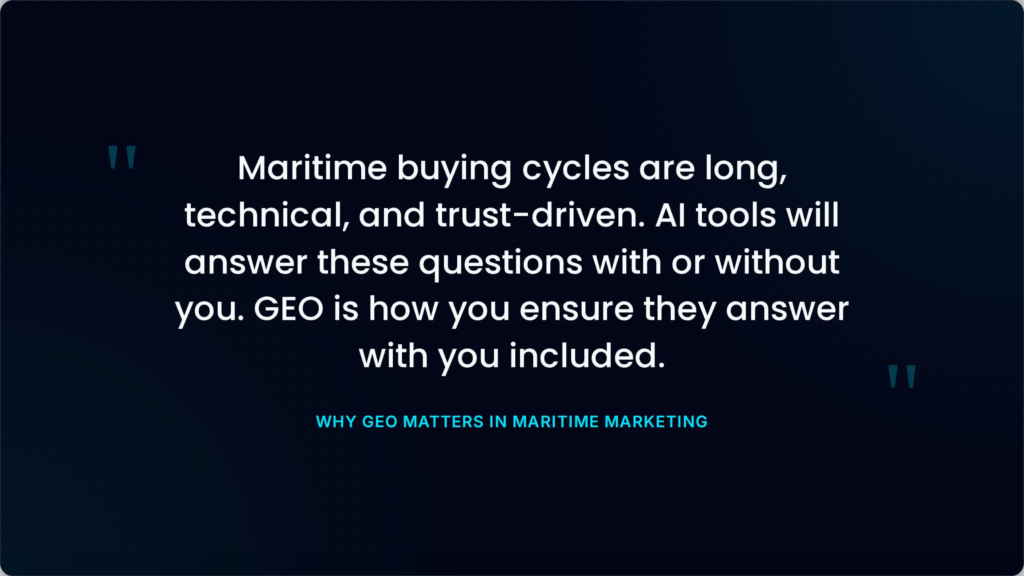
Maritime buying cycles are long, technical, and trust-driven. Your prospects ask questions like:
- “Which ship management companies specialise in LPG carriers?”
- “What’s the difference between BWTS retrofit options for Handymax bulkers?”
- “How do I choose a maritime cybersecurity provider compliant with IMO guidance?”
AI tools will answer these questions with or without you. GEO is how you ensure they answer with you included—accurately.
How AI systems choose what to include
While each platform differs, most AI answer systems reward content that is:
- Clear and structured
- Consistent and specific
- Credible and referenced
- Easy to parse (machine-scannable)
- Aligned to the user’s intent
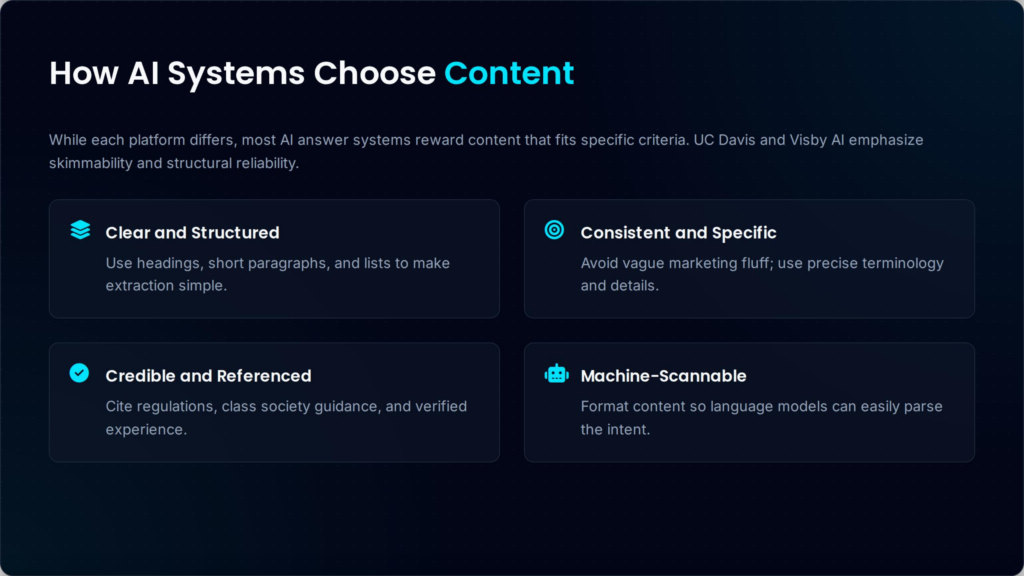
UC Davis’ GEO best practices emphasise skimmability, simple language, strong structure, descriptive links, and citing credible sources (source: https://iet.ucdavis.edu/aggie-ai/optimizing-content/geo-best-practices). Visby AI similarly highlights the need for content that can be reliably surfaced and used by generative engines (source: https://visby.ai/blogs/generative-engine-optimization-best-practices-for-beginners).
GEO best practice #1: Write for answers, not just rankings
Classic SEO often starts with “What keyword do we want to rank for?” GEO starts with:
- What question is the buyer asking?
- What would a correct, compliant, technically sound answer look like?
- What supporting details reduce uncertainty?
Practical maritime example
Instead of publishing a vague service page titled “Ship Agency Services”, build an answer-driven resource such as:
- “Ship Agency Services: Scope, Responsibilities, and Port Call Checklist”
- Include a short definition, what’s included, what’s excluded, common timelines, and documentation requirements.
AI systems are more likely to quote content that reads like a precise reference.

GEO best practice #2: Put the summary up top (and make it concrete)
Generative engines love content that is easy to summarise—because they are summarising.
Follow the skimmability guidance: include a short summary at the start of the article (source: https://iet.ucdavis.edu/aggie-ai/optimizing-content/geo-best-practices).
A simple pattern that works
At the top of each page, add:
- 2–4 sentence executive summary
- A short bullet list of key takeaways
- A clear statement of who this applies to (e.g., owners, charterers, technical managers)
This is especially effective for maritime topics where readers need context quickly.
GEO best practice #3: Use clean structure (H2s, H3s, bullets, and tables)
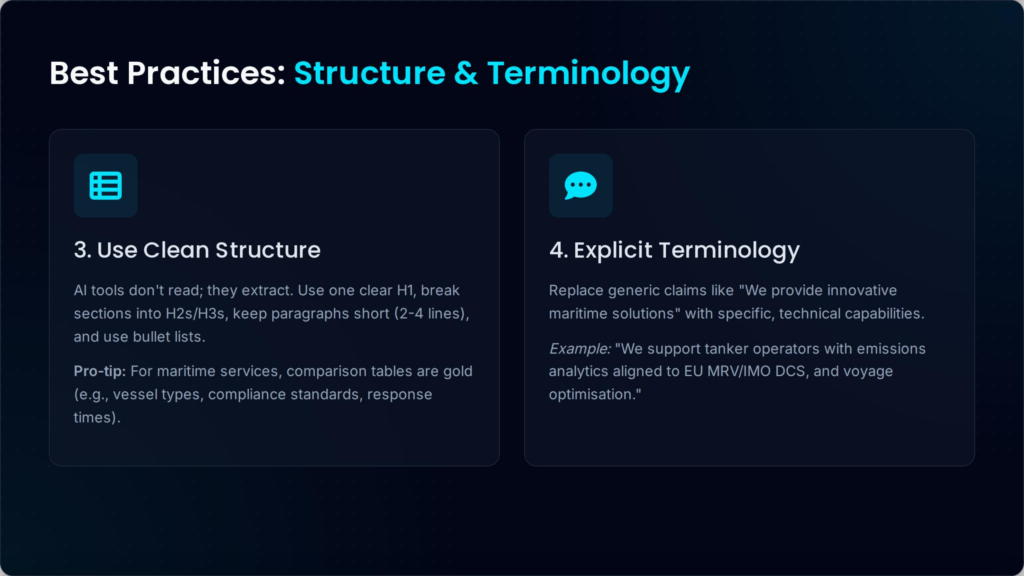
AI tools do not “read” like humans. They extract and interpret. That’s why structure matters.
UC Davis explicitly calls out headings, short paragraphs, lists, descriptive links, and image alt text (source: https://iet.ucdavis.edu/aggie-ai/optimizing-content/geo-best-practices).
What to do on every page
- Use one clear H1
- Break sections into H2s and H3s
- Keep paragraphs short (2–4 lines)
- Use bullet lists for requirements, steps, options, pros/cons
- Add tables where comparison matters (e.g., “Option A vs Option B”)
For maritime services, comparison tables are gold—think vessel types, trading regions, compliance standards, response times, or integration capabilities.
GEO best practice #4: Make terminology explicit (avoid vague marketing language)
AI systems reward specificity. Maritime buyers do too.
If you say you provide “end-to-end solutions,” an AI model can’t easily map that to a concrete capability. If you say “24/7 DPA incident response for ISM and cyber events,” that’s explicit.
Do this instead of generic claims
Replace:
- “We provide innovative maritime solutions.”
With:
- “We support tanker operators with vessel performance reporting, noon data validation, emissions analytics aligned to EU MRV/IMO DCS, and voyage optimisation support.”
The more your content reads like a technical spec (without becoming unreadable), the more usable it becomes in AI answers.
GEO best practice #5: Build topical authority with clusters (not one-off posts)
For maritime brands, topical authority beats sporadic content every time.
Example cluster: “Maritime Decarbonisation”
Create a hub page and supporting content such as:
- “IMO CII explained for shipowners”
- “EU ETS for maritime: what changes operationally?”
- “MRV vs DCS: differences and reporting timelines”
- “What data you need for emissions reporting (checklist)”
- “How voyage optimisation impacts CII”
Interlink them clearly. AI systems benefit from the context network, and prospects get a journey that matches how they learn.
GEO best practice #6: Add credibility signals (sources, standards, and citations)
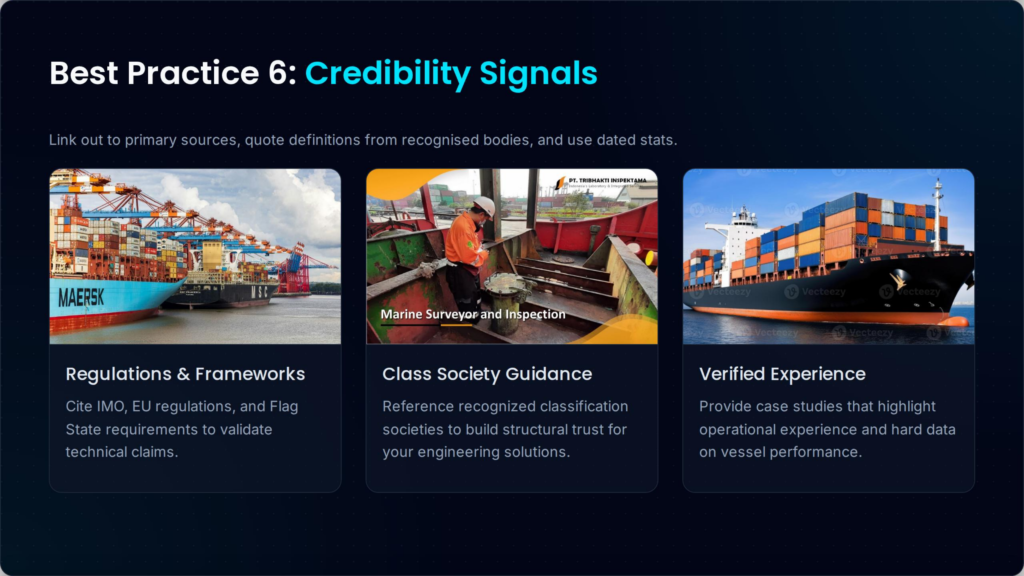
When AI systems choose content, credibility matters. UC Davis recommends citing credible sources, adding reference links, quotes, and statistics (source: https://iet.ucdavis.edu/aggie-ai/optimizing-content/geo-best-practices).
In maritime, credibility often comes from:
- Regulations (IMO, EU)
- Class society guidance
- Flag state requirements
- Industry frameworks and standards
- Published technical papers
- Verified operational experience (case studies)
Minimum viable approach
On key informational pages:
- Link out to primary sources where relevant
- Quote definitions from recognised bodies (with attribution)
- Use dated stats (and cite where they came from)
This increases the chance an AI model will treat your page as “safe to cite.”
GEO best practice #7: Strengthen your entity signals (who you are, what you do, where you operate)
Generative engines often struggle with ambiguous brands. Make it easy:
- Clear company description (one sentence)
- Specific services and industries served
- Geographic coverage (regions/ports)
- Certifications and memberships (where appropriate)
- Named subject-matter experts (with bios)
This supports what GEO aims to do: make your brand easy to select and reference in generated answers (source: https://visby.ai/blogs/generative-engine-optimization-best-practices-for-beginners).
GEO best practice #8: Optimise for “quote-ability”
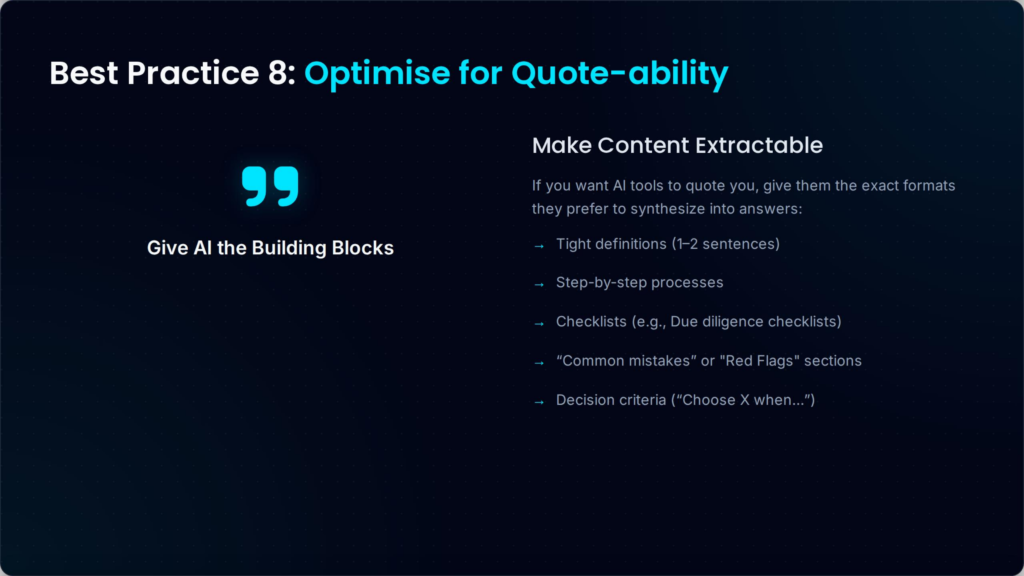
If you want AI tools to quote you, give them quotable building blocks:
- Tight definitions (1–2 sentences)
- Step-by-step processes
- Checklists
- “Common mistakes” sections
- Decision criteria (“Choose X when…”)
Maritime example: “How to choose a ship manager”
Include:
- Due diligence checklist
- KPIs to request (PSC detention rate, incident frequency, crew retention, vetting performance)
- Contract considerations
- Red flags
These are exactly the content units AI systems like to extract into answers.
GEO best practice #9: Use descriptive links and meaningful media text
UC Davis calls out descriptive links and alt text for images as part of optimising content for genAI systems (source: https://iet.ucdavis.edu/aggie-ai/optimizing-content/geo-best-practices).
What that looks like
Instead of:
- “Click here”
Use:
- “Download the port call documentation checklist (PDF)”
For images:
- Don’t use alt text like “image1”
- Use: “EU ETS maritime emissions reporting workflow diagram”
This improves both accessibility and machine interpretability.
GEO best practice #10: Measure visibility where AI answers happen
Traditional analytics won’t fully tell you if you’re being mentioned in AI-generated responses. GEO requires a different mindset:
- Track branded queries + core service queries in major AI tools
- Check if your brand is cited, mentioned, or recommended
- Monitor whether the summary is accurate
A simple beginner routine (monthly)
- Pick 20 priority questions your buyers ask
- Test them in ChatGPT/Gemini/Perplexity (and relevant AI search experiences)
- Record: mentions, citations, competitors shown, and narrative accuracy
- Update content to fill gaps or correct misinterpretations
Common beginner mistakes (and how to avoid them)
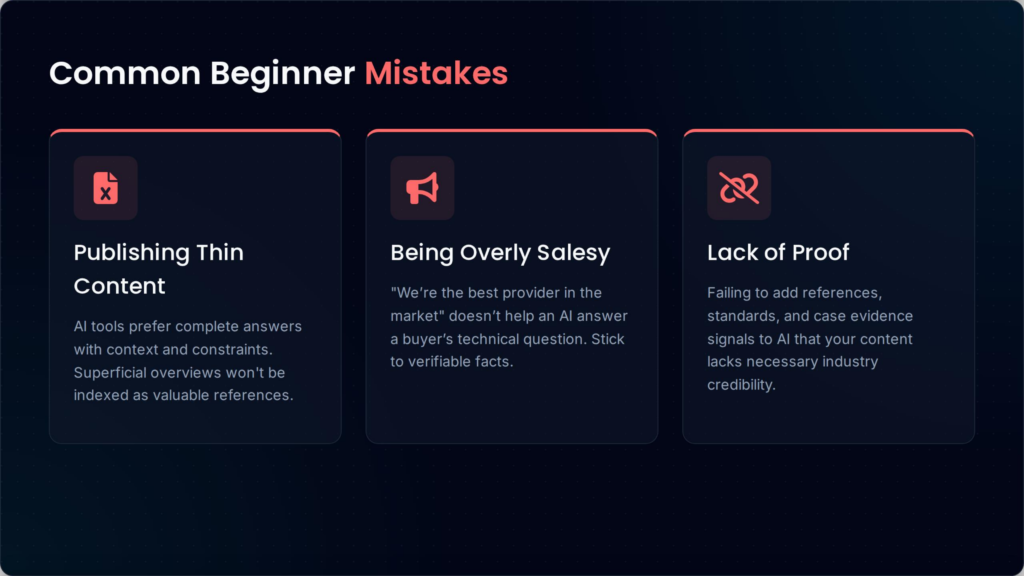
- Publishing thin content.
- AI tools prefer complete answers with context and constraints.
- Being overly salesy.
- “We’re the best” doesn’t help an AI answer a buyer’s question.
- Ignoring structure.
- Poor formatting makes your content harder to extract and reuse (source: https://iet.ucdavis.edu/aggie-ai/optimizing-content/geo-best-practices).
- No proof.
- Add references, standards, and case evidence (source: https://iet.ucdavis.edu/aggie-ai/optimizing-content/geo-best-practices).
- Treating GEO as a one-time task.
- GEO is iterative: publish, test, refine, and expand topical depth.
A practical GEO starter plan for maritime companies (30–60 days)
If you’re new to GEO, don’t boil the ocean. Start with what will move the needle.
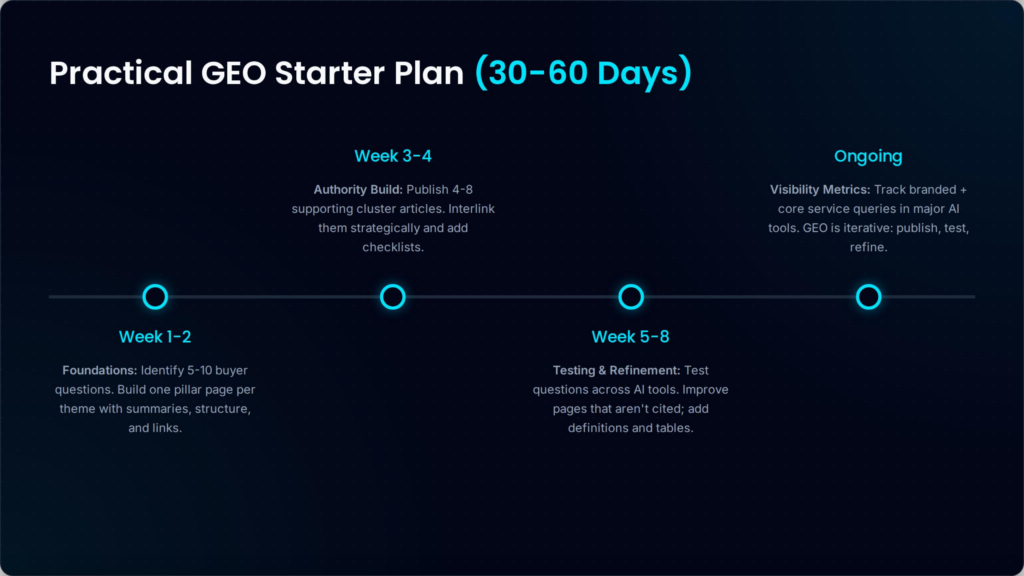
Week 1–2: Foundations
- Identify 5–10 buyer questions with commercial intent
- Build or improve one “pillar” page per theme
- Add summaries, structure, and credibility links
Week 3–4: Authority build
- Publish 4–8 supporting articles (cluster model)
- Interlink them strategically
- Add one downloadable checklist or template
Week 5–8: Visibility testing + refinement
- Test the questions across AI tools
- Improve pages that aren’t being used or cited
- Add clearer definitions, tables, and FAQs
This aligns with the beginner-focused GEO approach: make your content easy to interpret, trustworthy, and reusable in AI answers.
Final thoughts: GEO is maritime visibility in the AI era
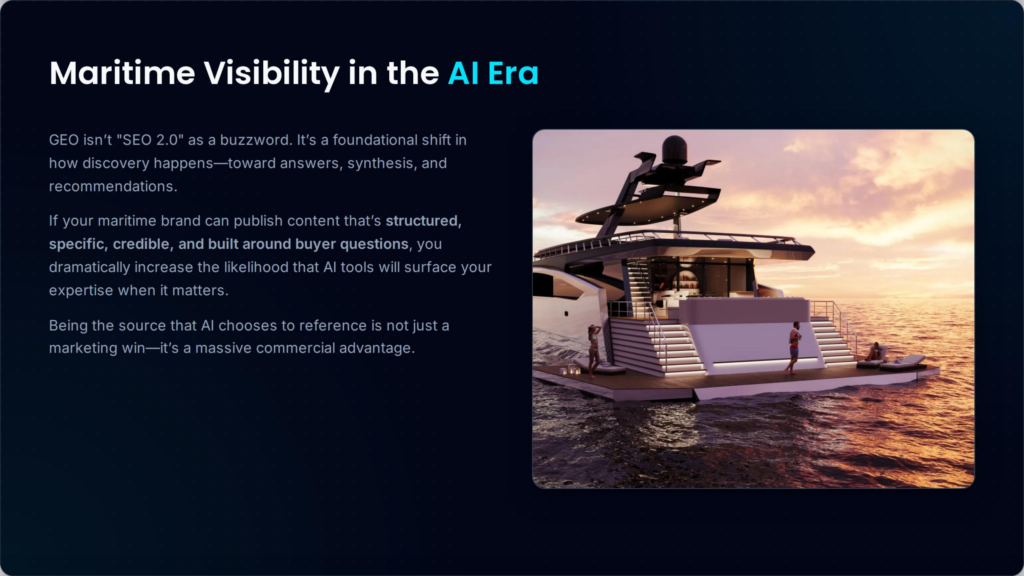
GEO isn’t “SEO 2.0” as a buzzword. It’s a shift in how discovery happens—toward answers, synthesis, and recommendations. If your maritime brand can publish content that’s structured, specific, credible, and built around buyer questions, you dramatically increase the likelihood that AI tools will surface your expertise when it matters.
And in a sector where trust, compliance, and competence are everything, being the source that AI chooses to reference is not just a marketing win—it’s a commercial advantage.
Sources:
- Visby AI — “Generative Engine Optimization Best Practices for Beginners”: https://visby.ai/blogs/generative-engine-optimization-best-practices-for-beginners
- UC Davis IET — “GEO Best Practices”: https://iet.ucdavis.edu/aggie-ai/optimizing-content/geo-best-practices
/hi

Ready to improve how AI engines talk about your brand?
If you want your maritime business to show up more often—and more accurately—in ChatGPT, Gemini, and other AI-driven discovery channels, Maritime Marketing can help. We offer done-for-you Generative Engine Optimization (GEO) built specifically for maritime brands: content strategy and creation, entity and authority building, technical structuring for AI readability, and ongoing optimization to increase your “cited-by-AI” visibility.
Prefer to manage it in-house? We can also get you set up with Visby.AI (the self-managed GEO software) with exclusive access at 40% off the standard price ( Only 10 Seats are available for a limited time), so your team can track AI visibility, benchmark competitors, and turn insights into an execution plan. Reply or contact Maritime Marketing to book a GEO discovery call, and we’ll recommend the fastest path—fully managed support or the DIY Visby.AI route—based on your goals and capacity.