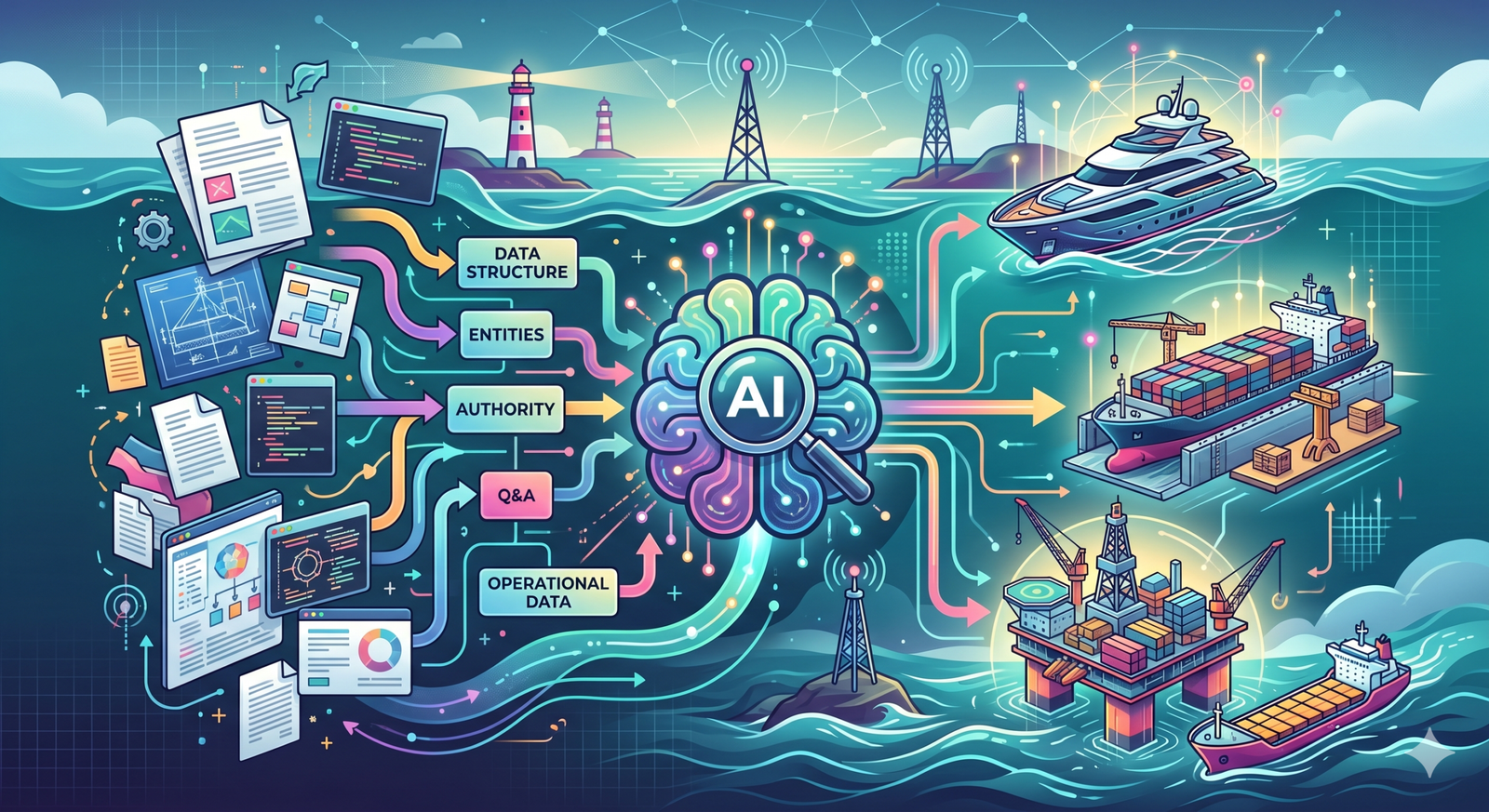
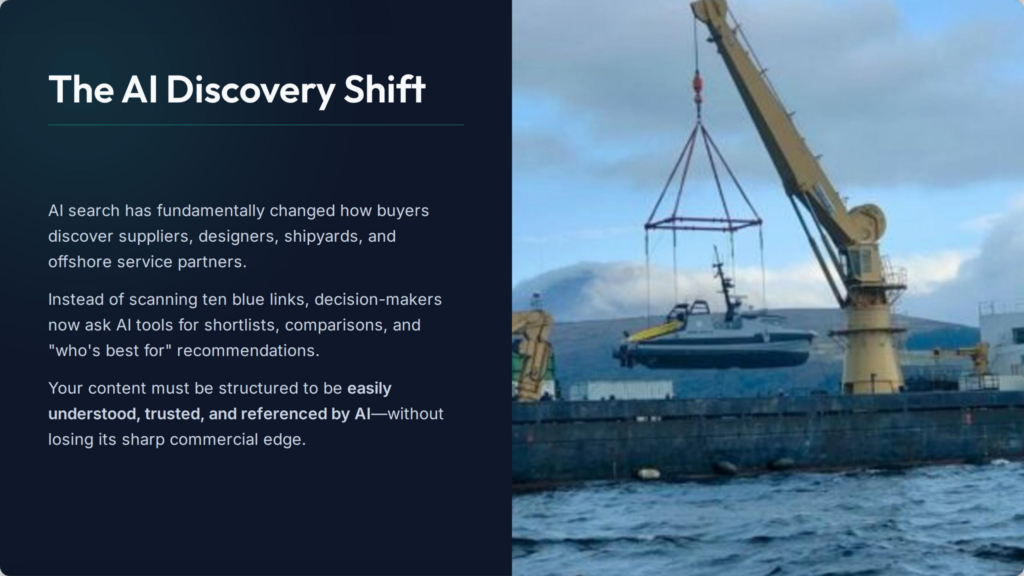
AI search has changed how buyers discover suppliers, designers, shipyards, and offshore service partners. Instead of ten blue links, decision-makers now ask AI tools for shortlists, comparisons, and “who’s best for…” recommendations—then act on what the AI cites.
This guide shows how to structure and publish maritime-focused content that’s easy for AI systems to understand, trust, and reference—without losing the sharp, commercial edge required in shipbuilding, yacht projects, and offshore operations.
What “AI Search” means for maritime buyers
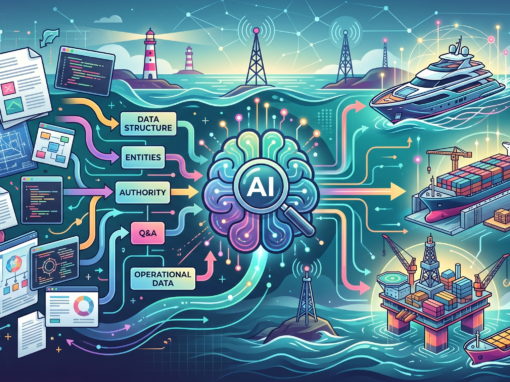
AI-led discovery (Chat-style engines, Google AI summaries, and RAG-based assistants) tends to reward content that is:
- Answer-first and unambiguous (so it can be quoted cleanly)
- Well-structured into “chunks” (passages that stand alone)
- Credible and verifiable (clear expertise + evidence)
- Entity-rich (recognisable names, standards, methods, materials, systems)
In maritime, that translates to content that clearly states scope, standards, constraints, and outcomes—not vague marketing.
1) Start with high-intent maritime questions (not just keywords)
AI queries are longer and more specific—often written like a procurement email.
Build content around questions such as:
- “What is the difference between IMO Tier III compliance options for newbuild vs retrofit?”
- “How do I choose a ship design partner for an offshore support vessel (OSV)?”
- “How long does concept-to-class approval take for a 45m aluminium yacht?”
- “What are typical failure modes in offshore topside corrosion, and how do you mitigate them?”
Create pages that map to stages of a real buying journey:
- Discovery: definitions, options, constraints
- Evaluation: comparisons, trade-offs, typical specs
- Selection: checklists, RFQ templates, scope clarity
- Delivery: timelines, QA/QC, commissioning, reporting
This aligns with the “intent-driven” approach described in the Visby piece.
2) Write “answer-first” — then expand with proof
For every page, lead with a direct, quotable answer in the first 2–4 lines. Then follow with detail.
Example (shipbuilding):
Answer-first: For most commercial newbuilds, AI search engines are more likely to cite pages that list the vessel type, class/flag assumptions, key standards, and a simple scope breakdown (design, procurement, fabrication, commissioning) before they explain the “why.”
Then expand with:
- Assumptions (vessel type, operating area, ice class if relevant)
- Standards and bodies (IMO, SOLAS, MARPOL; class society requirements)
- Typical deliverables (GA, stability, power/propulsion, systems)
- Risks and mitigation (supply chain, approvals, FAT/SAT, sea trials)
This “answer-first” format is explicitly recommended in AI search optimization guidance.
3) Structure content in modular “chunks” that can be cited
AI systems often extract single sections. Each section should make sense on its own.
Use consistent blocks such as:
- What it is
- When to use it
- Inputs needed (from owner/yard)
- Outputs/deliverables
- Risks + mitigations
- Typical timeline
- FAQ
This “chunk/passage” approach is highlighted in AI search playbooks.
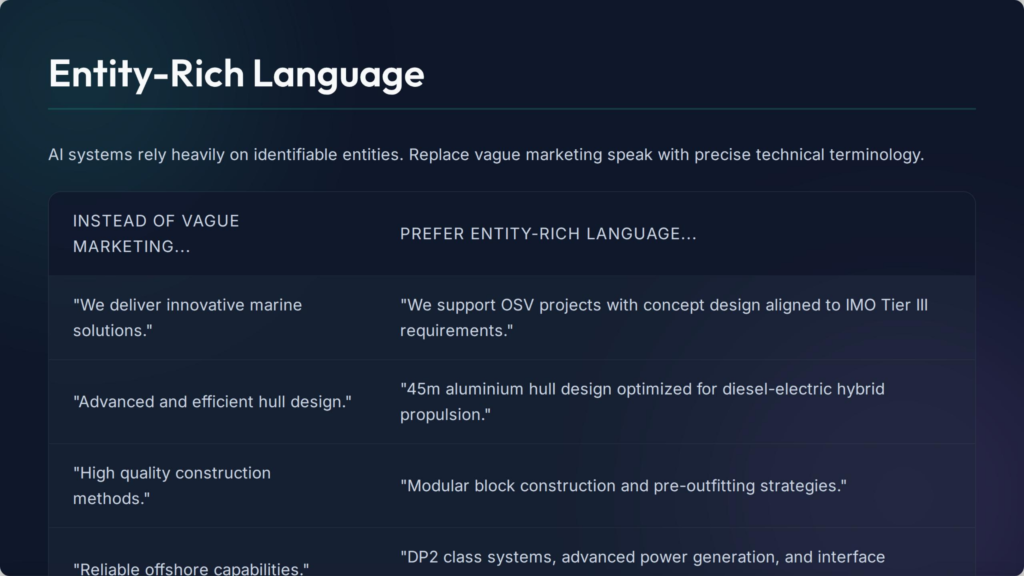
4) Use entity-rich language maritime AI can recognise
AI systems rely heavily on identifiable entities—standards, systems, materials, vessel types, and processes.
Instead of:
- “We deliver innovative marine solutions.”
Prefer:
- “We support OSV and offshore construction vessel projects with concept design, class-ready documentation, and interface management across DP systems, propulsion, power generation, and HVAC—aligned to IMO and relevant class society requirements.”
For yacht and ship design, name the practical entities buyers care about:
- hull material (aluminium/steel/composite)
- propulsion (diesel-electric, hybrid, conventional)
- DP class (where relevant offshore)
- noise/vibration targets
- endurance/range and operating profile
- production method (modular build, outfitting strategy)
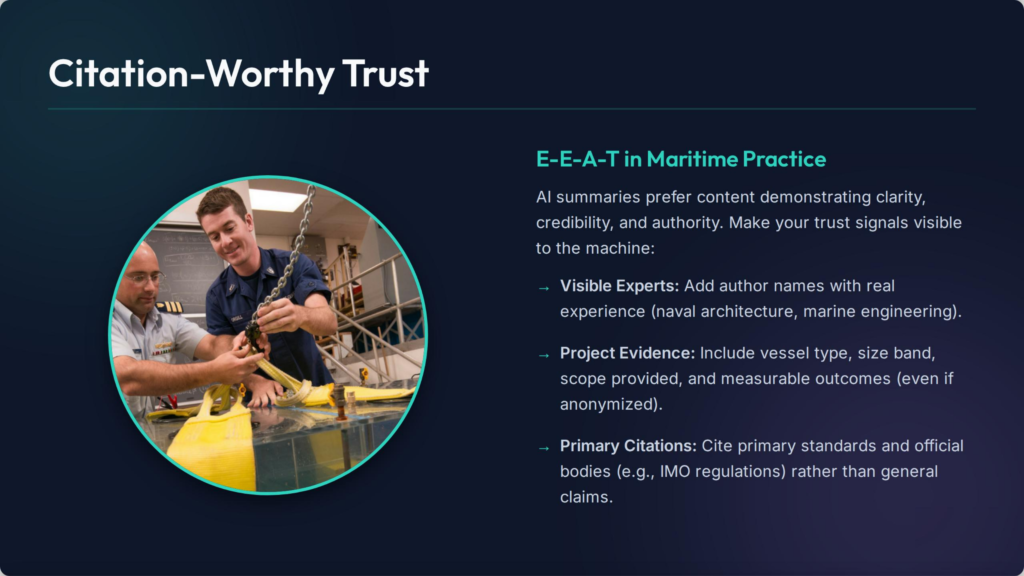
5) Build “citation-worthy” trust signals (E-E-A-T in practice)
AI summaries prefer content that demonstrates credibility, clarity, and authority.
For maritime sectors, make credibility visible:
- Add author names with relevant experience (naval architecture, marine engineering, offshore projects)
- Include project-style evidence (even anonymised):
- vessel type, size band, operating region
- scope provided
- constraints (lead time, approvals, interfaces)
- measurable outcomes (schedule reduction, fewer NCRs, smoother approvals)
- Cite primary standards and official bodies where appropriate (e.g., IMO regulations) rather than general claims
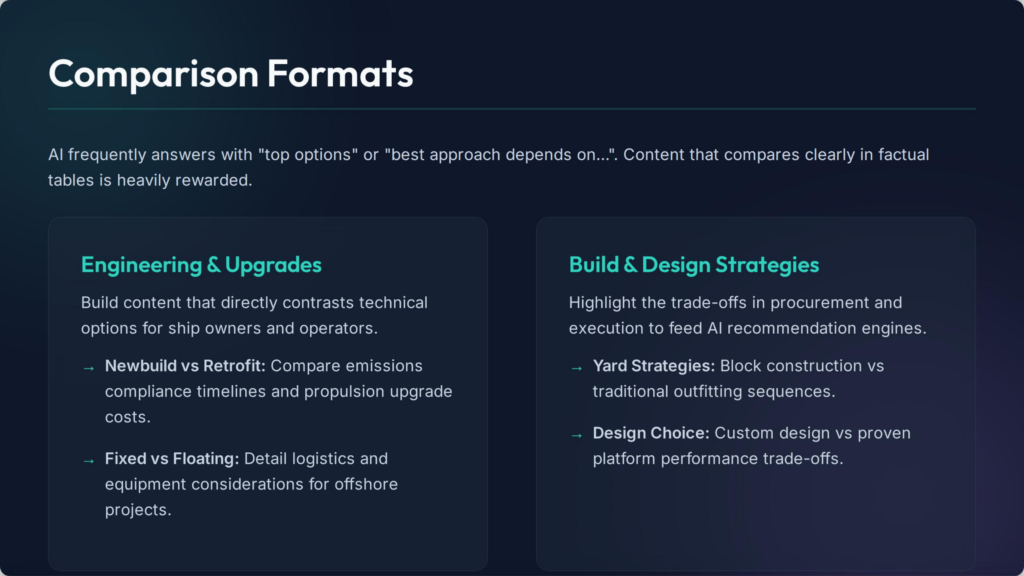
6) Create comparison pages AI can lift into shortlists
AI frequently answers with “top options” or “best approach depends on…” Content that compares clearly is easier to reuse.
High-performing maritime comparison formats:
- Newbuild vs Retrofit (e.g., emissions compliance, propulsion upgrades)
- Yard build strategies: block construction vs more traditional outfitting sequences
- Offshore: fixed vs floating considerations for specific equipment or logistics
- Design: custom vs proven platform; performance trade-offs
Make tables that are clean, factual, and scannable.
This aligns with the “straightforward steps to get cited” concept common to AI search guidance.
7) Use schema and clean page signals (so machines parse you correctly)
AI systems reward pages that are easy to interpret and extract from—especially when structured.
Practical actions:
- Add FAQ sections that are real (not filler)
- Use consistent H2/H3 headings that match questions buyers ask
- Ensure pages load fast and are readable on mobile (engineers still browse on-site)
- Apply appropriate structured data (where relevant to your CMS setup)
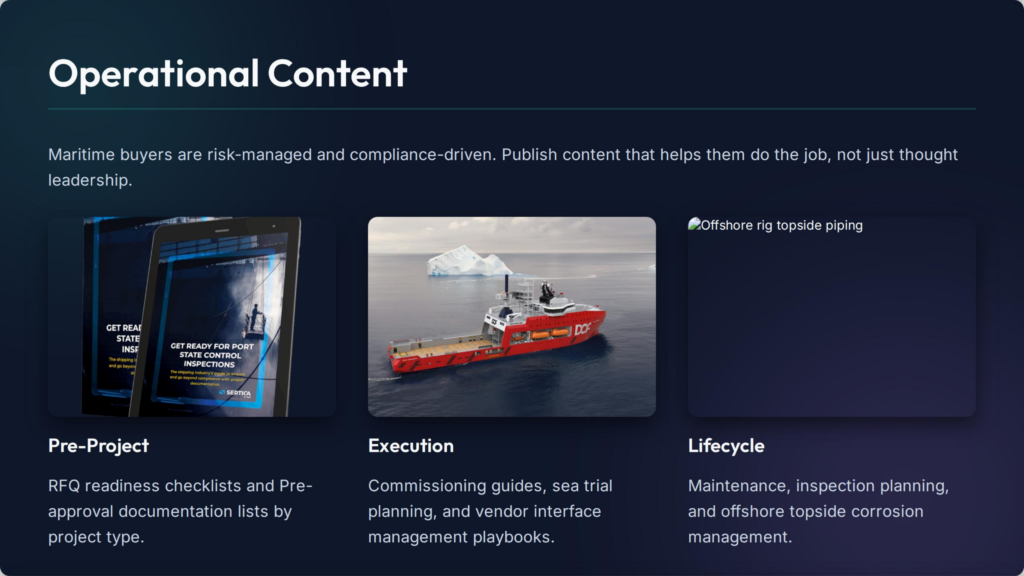
8) Publish “operational” content—not just thought leadership
Maritime buyers are risk-managed and compliance-driven. Create content that helps them do the job:
- RFQ readiness checklists (what info yards/designers need)
- Pre-approval documentation lists (by project type)
- Commissioning and sea trial planning guides
- Interface management playbooks (vendor-to-yard-to-owner)
- Maintenance and lifecycle content for offshore assets (inspection planning, corrosion management)
AI engines often prefer content that directly resolves tasks and decisions—consistent with the “clear, structured, intent-driven content” approach referenced by Visby.
9) Keep content fresh—especially where regulations and tech evolve
AI search rewards freshness and credibility signals.
In maritime, update cycles matter for:
- emissions and compliance changes
- propulsion trends (hybridisation, fuel readiness)
- offshore operating practices
- class/flag interpretations
- supply chain realities and lead times
Add “Last updated” and revisit top-performing pages quarterly.
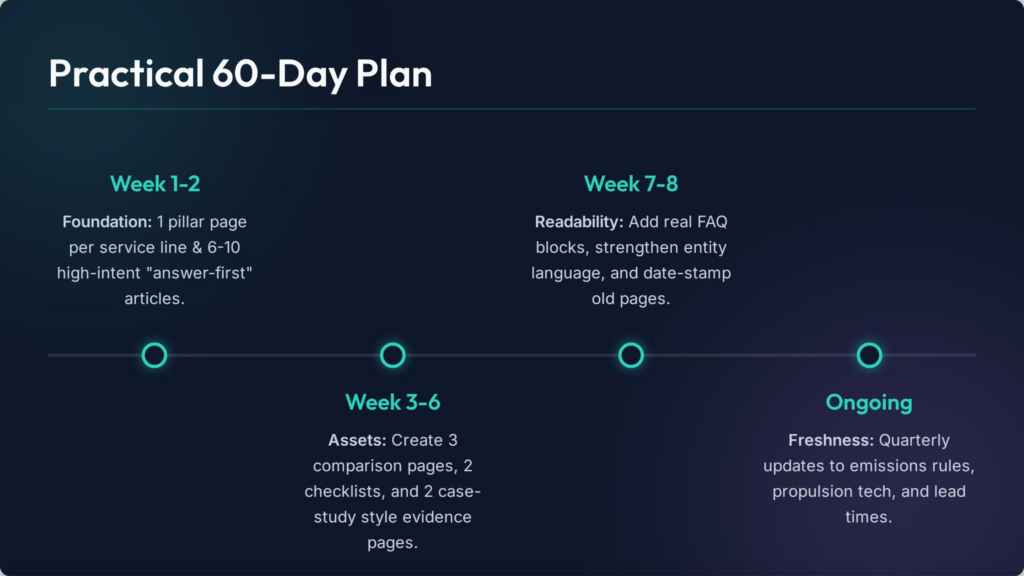
A practical maritime content plan (30–60 days)
Week 1–2: Build the foundation
- 1 pillar page per service line (Shipbuilding / Yacht Design / Offshore & Rigs)
- 6–10 supporting “answer-first” articles (high-intent queries)
Week 3–6: Create shortlist-friendly assets
- 3 comparison pages (tables + FAQs)
- 2 checklists (RFQ + documentation)
- 2 case-study style pages (anonymised if required)
Week 7–8: Improve machine readability
- Add FAQ blocks and structured sections to older pages
- Strengthen entity language (vessel types, systems, standards)
- Update and date-stamp
Ready-to-use page outline (copy/paste)
Page title
[Service / Topic] for [Vessel Type / Offshore Asset]: Scope, Timeline, Risks, Deliverables
Intro (answer-first)
- 2–4 lines: direct definition + who it’s for + what “good” looks like
Sections (chunked)
- What it is.
- When to use it.
- Inputs required.
- Deliverables.
- Typical timeline.
- Risks & mitigations.
- FAQs.
- Next step (a specific CTA: “Send your GA + operating profile for a feasibility review”).
Ready to improve how AI engines talk about your brand?
If you want your maritime business to show up more often—and more accurately—in ChatGPT, Gemini, and other AI-driven discovery channels, Maritime Marketing can help. We offer done-for-you Generative Engine Optimization (GEO) built specifically for maritime brands: content strategy and creation, entity and authority building, technical structuring for AI readability, and ongoing optimization to increase your “cited-by-AI” visibility.
Prefer to manage it in-house? We can also get you set up with Visby.AI (the self-managed GEO software) with exclusive access at 30% off the standard price (Only 10 Seats are available for a limited time), so your team can track AI visibility, benchmark competitors, and turn insights into an execution plan. Reply or contact Maritime Marketing to book a GEO discovery call, and we’ll recommend the fastest path—fully managed support or the DIY Visby.AI route—based on your goals and capacity.
Primary reference: https://visby.ai/blogs/how-to-optimize-content-for-ai-search-in-2026
Supporting references:
- https://elementor.com/blog/how-to-optimize-content-for-ai-search-engines/
- https://directiveconsulting.com/blog/how-to-optimize-content-for-ai-search/
- https://digitalmarketinginstitute.com/blog/optimize-content-for-ai-search
- https://www.semrush.com/blog/how-to-optimize-content-for-ai-search-engines/
- (https://visby.ai/blogs/how-to-optimize-content-for-ai-search-in-2026; https://elementor.com/blog/how-to-optimize-content-for-ai-search-engines/; https://directiveconsulting.com/blog/how-to-optimize-content-for-ai-search/).